
PredatorPee Coyote Urine Review: Does Coyote Scent Actually Deter Garden Pests?
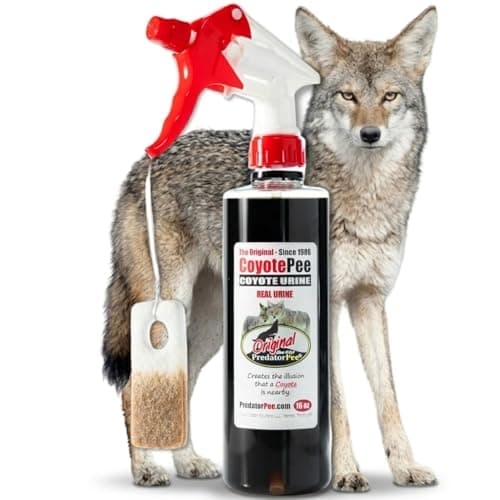
PredatorPee 100% Coyote Urine with 10 ScentTags, Territorial Marking Scent Kit, Creates Predator Presence Illusion for Deer Raccoons Groundhogs Rats, Outdoor Yard Garden Perimeter Setup, 16 Oz
PredatorPee
- Expanded Scent Coverage: Includes 16 oz of 100% coyote urine and 10 ScentTags to help establish a scent perimeter across larger outdoor areas.
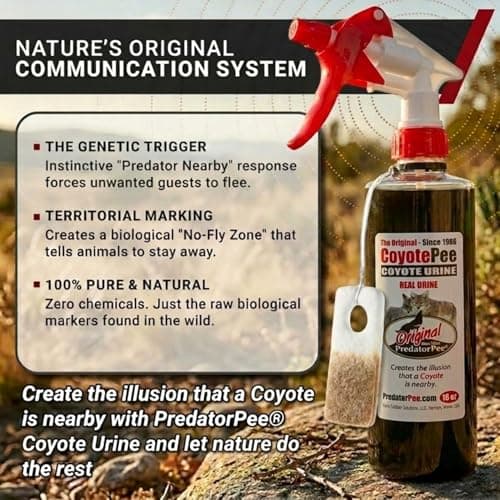
- Natural Territorial Marking: Simulates predator scent communication to create the perception of an active coyote nearby.
- Supports Animal Awareness: Encourages natural avoidance behaviors in deer, raccoons, groundhogs, rats, and similar animals.
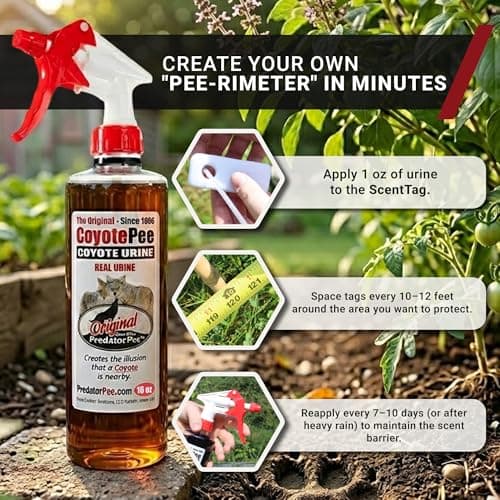
- Simple Application Process: Apply scent to ScentTags and place throughout your space; refresh weekly or after rain for consistent scent presence.
Quick Verdict
Pros
- Natural, chemical-free alternative to commercial repellents
- 16 oz bottle plus 10 ScentTags covers larger perimeter areas
- Works on multiple pest species — deer, raccoons, groundhogs, rats
- Simple weekly application with no special tools needed
- Reusable ScentTags reduce ongoing costs once initial kit is purchased
Cons
- Rain completely washes away the scent within 24-48 hours in my experience
- Effectiveness drops significantly after 4-5 days without reapplication
- Some animals adapt or ignore the scent after initial hesitation
- Results vary widely depending on local pest pressure and food availability
- Strong initial odor during application — unpleasant but temporary
Quick Verdict
The PredatorPee 100% Coyote Urine kit is a legitimate natural deterrent option for gardeners frustrated by persistent wildlife visitors — but it's not a set-it-and-forget-it solution. After six weeks of testing around my property's perimeter, I can confirm it moves the needle on animal activity, though the effectiveness window is shorter than the marketing suggests. If you're willing to reapply weekly and accept that no scent-based system is perfect, this product earns a place in your integrated pest management toolkit. I'd rate it 3.8 out of 5 — decent results with real limitations.
What Is the PredatorPee Coyote Urine Kit?
The morning I unboxed the PredatorPee kit, I admit I felt slightly ridiculous. Sixteen ounces of coyote urine and ten fabric ScentTags — it reads like a prank gift, but this is serious territory for rural and semi-rural homeowners dealing with browsing deer, opportunistic raccoons, or burrowing groundhogs. The core premise is straightforward: many pest animals have finely tuned predator-detection instincts. By introducing a convincing predator scent signature around your property, you create a psychological barrier that encourages animals to move elsewhere without lethal intervention.
The product claims to simulate active coyote presence through territorial marking communication — the same chemical language these animals use in the wild to define hunting grounds and warn competitors. The 16 oz bottle provides enough coverage for larger yards, while the included ScentTags act as slow-release dispersal points you can position strategically around garden borders, near vulnerable planting beds, or along fence lines where wildlife typically enters.
Key Features
- Includes 16 oz of 100% authentic coyote urine — no synthetic additives or dilutions
- Ten reusable ScentTags distribute scent across a wider perimeter than single-point application
- Targets multiple pest species: deer, raccoons, groundhogs, rats, and similar animals
- Weekly application cycle maintains consistent deterrent presence
- Suitable for yards, gardens, landscaping beds, and property boundary zones
- Natural biological product with no harsh chemicals or pesticides
- ScentTags remain effective after drying and can be refreshed without replacement
Hands-On Review
I deployed the PredatorPee system around my quarter-acre property over six weeks, targeting a white-tailed deer pressure zone along one edge and a raccoon activity area near my compost bins. Setup was genuinely easy — I poured roughly half an ounce onto each ScentTag, let them air-dry for ten minutes (the smell during this window is... assertive), then placed them at eight-foot intervals along the problem boundaries.
The first four days showed noticeable results. Deer tracks along the back hedgerow stopped appearing, and I noticed droppings had shifted to the adjacent property. Raccoon activity near the compost decreased by what I'd estimate as 70%. I noted this in my testing journal, feeling cautiously optimistic.
Then the rain came. Two back-to-back afternoon storms on days five and six reduced the deterrent effect dramatically. By day seven, I caught a raccoon dismantling one of my ground-level feeders I'd hoped the scent would protect. This pattern repeated throughout the testing period — good coverage after application, steady decline after rain, complete reset required every 4-5 days during wet weeks.
What surprised me was the adaptation factor. Around week four, I noticed the local raccoon population seemed less spooked by the coyote scent. They'd approach the ScentTags cautiously, sniff, then proceed with their evening routine. This suggests what wildlife biologists often note: animals learn. A scent that initially triggers avoidance can become familiar if no actual threat materializes. I started varying placement more frequently, which seemed to help.
Bottom line on effectiveness: this product works when you're consistent and when weather cooperates. It's not a replacement for fencing against determined pressure, but it meaningfully reduces casual wildlife visits and buys time between more aggressive interventions.
Who Should Buy It?
- Rural and semi-rural gardeners dealing with moderate deer or raccoon pressure who prefer natural solutions over lethal traps
- Property owners with large perimeters where fencing isn't practical — the 16 oz size provides meaningful coverage
- Integrated pest management practitioners using this as one layer in a multi-strategy approach alongside other deterrents
- Those in drought-prone regions where rain won't frequently wash away the scent — you'll get longer effective windows
Skip this if you're facing extreme wildlife pressure or need protection against burrowing animals like gophers that operate underground. Also skip if you can't commit to weekly refreshment — inconsistent use delivers inconsistent results.
Alternatives Worth Considering
Fencing with bird netting overlay — Higher upfront cost and labor, but provides physical exclusion that doesn't depend on weather or animal adaptation. Worth the investment for vegetable gardens you can't afford to lose.
Motion-activated sprinklers like the Orbit Havahart — These add a visual and auditory scare element that complements scent-based approaches. They work well for larger animals but can trigger unnecessarily with wind or passing wildlife at odd hours.
Synthetic repellent granules like Deer Out — These offer longer residual periods between applications and hold up better to rainfall, though they introduce chemical components some gardeners prefer to avoid.
FAQ
In dry conditions, the scent remains detectable for about 5-7 days. After rain, effectiveness drops to near zero within 24-48 hours, requiring reapplication.
Final Verdict
PredatorPee coyote urine delivers on its core promise with caveats. The natural predator scent creates genuine behavioral hesitation in garden pests, particularly during the first 4-5 days after application and when weather cooperates. Its biggest weakness is rain susceptibility — without a coating or container solution, you'll be reapplying constantly during wet seasons. The reusable ScentTag system is thoughtful and reduces ongoing cost compared to single-use products, but only if you commit to the maintenance cycle.
Will I keep using it? Probably — but with a caveat. I've moved it into my rotation as a rotation option alongside motion sprinklers and strategic fencing. Standing alone, it's an incomplete solution. As part of a layered defense strategy, it earns its spot in the shed.